
Health Tips
Healthy School Lunch Ideas Kids Will Actually Eat


If you’ve ever unpacked a lunchbox at the end of the day and found the crackers gone, the sandwich half eaten, and the carrots sitting exactly where you put them, you’re in good company.
Packing lunch sounds like it should be simple, but it rarely is. About 40% of US children bring lunch from home rather than buying it, and research offers a glimpse of what ends up inside: sweets turned up in 48% of packed lunches, and vegetables in only 17%.
That’s not a parenting failure; it’s a hard job. A lunchbox has to survive a warm backpack, a lunch period shorter than a cartoon, and a child with strong feelings about which foods are allowed to touch.
Here’s how to pack a healthy lunch your child will still enjoy.
Healthy lunch box basics
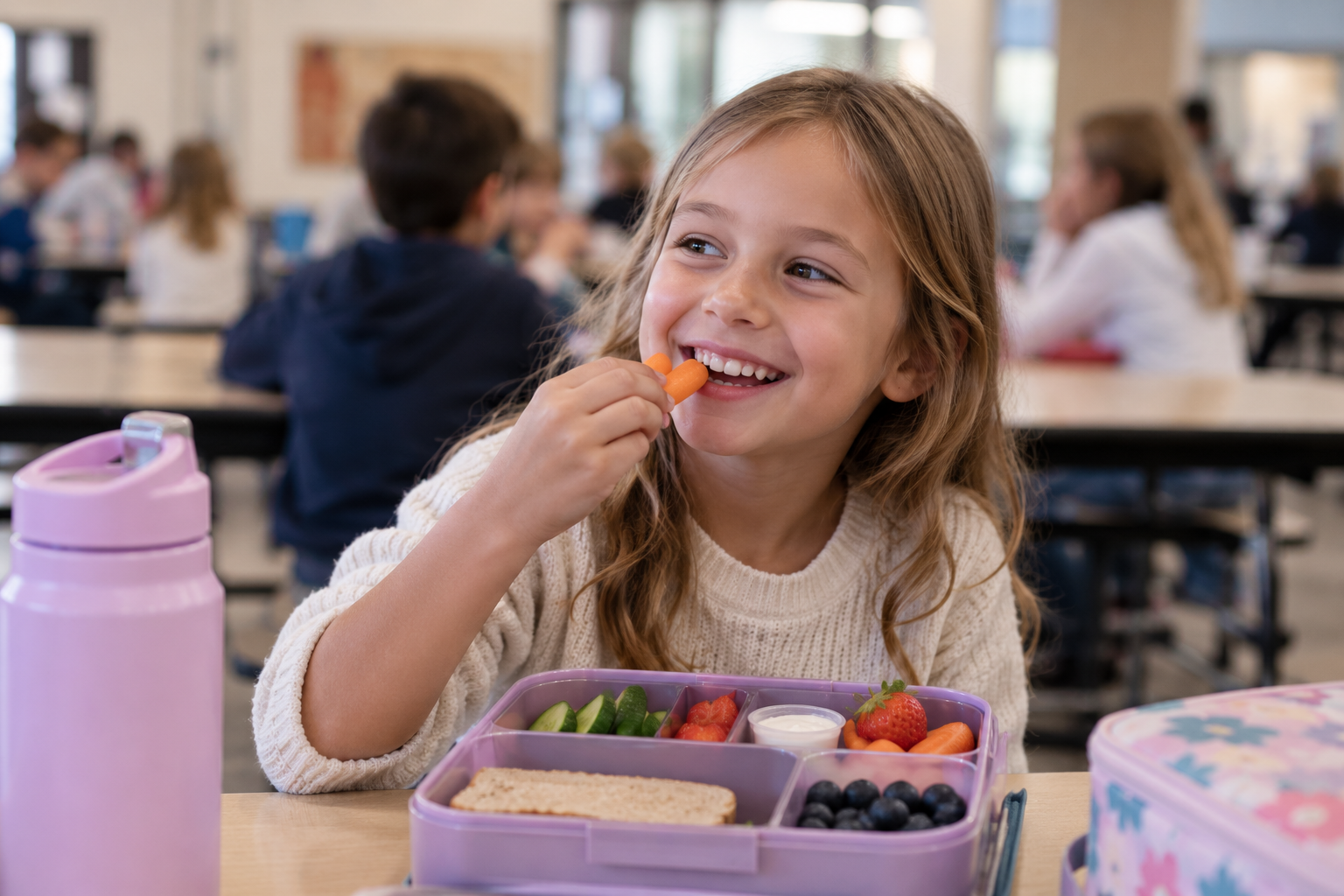
Every reimbursable school lunch has to offer five components, which are fruit, vegetables, grains, a protein, and milk. Those same standards can be applied to your child’s lunch from home. Fill about half the lunchbox with fruit and vegetables, split the rest between a whole grain and a protein, and send water or milk to drink.
-
Fruit. Apple slices, berries, grapes, or clementine segments.
-
Vegetables. Cucumber rounds, baby carrots, cherry tomatoes, or pepper strips.
-
Grains. Whole-wheat bread or tortillas, brown rice, oats, or whole-grain crackers.
-
Protein. Turkey, chicken, eggs, beans, cheese, yogurt, or hummus.
-
Calcium. Low-fat milk, a cheese stick, yogurt, or fortified soy milk.
High-protein lunch ideas for kids
Ever picked up a child who seems fine at 3 p.m. and falls apart by 3:15? Protein and fiber are what hold off that crash. Both digest slowly, so fullness stretches into the last class of the day instead of running out at 1 p.m. Fiber also keeps digestion regular, which helps any child prone to constipation and stomachaches.
Options that travel well:
-
Rolled deli turkey or chicken with cheese cubes and whole-grain crackers to build into stacks.
-
Hard-boiled eggs, peeled at home and sent whole or halved.
-
Hummus or bean dip with pita strips, pretzels, or pepper slices for scooping.
-
Greek yogurt or cottage cheese, sent frozen so it thaws cold by lunchtime.
-
Edamame or roasted chickpeas, eaten by hand with no utensils needed.
-
String cheese or cheese sticks, packed straight from the fridge with an ice pack alongside.
-
Turkey and cheese pinwheels, rolled in a whole-wheat tortilla and sliced into rounds.
-
Tuna or salmon pouches, spooned onto crackers with no draining required.
-
Shelf-stable turkey or beef sticks, sturdy enough to survive a warm backpack.
Extra tip: It also helps to pack for speed. Help your child make the most of their lunchtime by making things easier to eat. Cut the sandwich into quarters. Slice the apple. Open the stubborn wrappers at home and reseal them. Loosen any lid your child can't twist. A lunch period is shorter than the schedule suggests, because it also covers walking to the cafeteria, waiting in line, and finding a seat.
Research shows that timing also changes what children eat. With less than 20 minutes seated, kids ate 13% less of their main dish and 12% less of their vegetables than kids who had at least 25 minutes. Rushed students also took a fruit only 44% of the time, against 57% when they had longer. Given less time, they skipped it rather than hurried it.
School lunch ideas for picky eaters
A quick word about "picky." It's a commonly used term, but the label frames a normal stage of development as a problem to fix, and that pressure tends to shrink the list of accepted foods rather than grow it.
What works instead is repetition. Researchers found that when kids are introduced to new foods, the amount they ate increased with each offering and leveled off around the fourth try.
Here’s a few other research-backed tips about introducing new foods to your child:
- Keep offering it. If your child turned a food down last time, serve it again. Twice a week or once a week both work, so pick a frequency you can keep up.
- Small amounts are enough. Kids don't need a full serving for this to work.
- Early tries do real work, and later ones still count. Children often eat more of a new food within the first few offerings, but plenty of foods take many more tries before a child likes them. Keep offering.
- It sticks. Six months later, kids still liked the food more. A break doesn't undo it.
- Each food counts separately. The number of introductions begins again with every new food.
Sometimes refusal isn’t about preference at all. Texture, smell, and the noise of a crowded cafeteria all play a part, and those sensory sensitivities aren’t behavioral. If your child gags at certain textures, drops whole food groups, or eats from a list that keeps getting shorter, that pattern can point to sensory food aversion. Your clinician can help you tell the difference.
Lunch box food safety
A lunchbox sits in a warm backpack or a cubby for four or five hours before anyone opens it. Perishable food, meaning anything with meat, eggs, dairy, or cooked grains in it, needs to stay cold that whole time. An ice pack is the single most useful thing you can add, and it’s best at keeping cold food cold. It can't chill a sandwich that was warm to begin with.
Here's a few extra tips to keep your child’s food safe:
-
Use two ice packs, not one, and put one on top. Cold air sinks.
-
Chill the packed box overnight so it starts the morning cold instead of cooling down on the bus.
-
Freeze part of the lunch. A water bottle or a yogurt tube works as an ice pack and thaws throughout the day.
-
Preheat the thermos with boiling water for a few minutes, pour it out, then add hot food so soup or pasta stays hot.
-
Throw out perishable leftovers that come home. A half-eaten ham sandwich should not get repacked.
-
Wipe the box every night and wash the ice packs with soap and water. Crumbs and spilled yogurt are what make a lunch bag smell.
Nut-free lunch ideas and allergy safety
Food allergy affects up to 10% of children, and anaphylaxis happens in about 1 in 15 schools each year. It takes only one child in the room for the whole class to go nut-free, which is why peanut butter has quietly dropped off the menu in so many schools. If that's your child's classroom, the rule isn't negotiable, so here’s a few nut-free swaps:
- Sunflower seed butter or soy butter spreads and tastes close enough to peanut butter for most kids.
- Roasted chickpeas, pretzels, or popcorn cover the crunchy snack slot that trail mix used to fill.
- Hummus and pita or cheese and whole-grain crackers add protein with no nuts involved.
- Seed-based granola bars work, but check the small print. A bar with no nuts in the recipe can still be made on shared equipment, and that warning sits under the ingredients.
Check labels even on foods you have packed for years, since recipes and factories change.
When your own child has the allergy
A classroom ban is not the safeguard it appears to be. Nut products still turn up in schools that prohibit them, and the rule on its own has not been shown to prevent reactions.
Your child needs a written allergy and anaphylaxis emergency plan on file, signed by your clinician and renewed each year.
Lunch that actually gets eaten
A lunch that gets eaten comes down to four things:
- Build the box around the same components a school lunch has to offer, with about half of it being fruit and vegetables.
- Lead with protein to carry your child through the afternoon.
- Pack it cold the night before, because an ice pack can't rescue a warm sandwich.
- Keep sending the food your child ignored. Repetition helps, and most of the change happens in the first few tries.
Talk with your clinician if your child is eating less than they used to, if the list of accepted foods keeps shrinking, or if a reaction to a food has you worried.
Need a pediatrician who will partner with you to support your child's health needs? Schedule a visit with one of our clinicians.
References
1. Almansour, F. D., Sweitzer, S. J., Magness, A. A., Calloway, E. E., McAllaster, M. R., Roberts-Gray, C. R., Hoelscher, D. M., & Briley, M. E. (2011). Temperature of foods sent by parents of preschool-aged children. Pediatrics, 128(3), 519–523. https://pmc.ncbi.nlm.nih.gov/articles/PMC3164089/
2. Cohen, J. F. W., Jahn, J. L., Richardson, S., Cluggish, S. A., Parker, E., & Rimm, E. B. (2016). Amount of time to eat lunch is associated with children’s selection and consumption of school meal entrée, fruits, vegetables, and milk. Journal of the Academy of Nutrition and Dietetics, 116(1), 123–128. https://pubmed.ncbi.nlm.nih.gov/26372337/
3. HealthyChildren.org. (2025). Managing food allergies at school: Information for families. American Academy of Pediatrics. https://www.healthychildren.org/English/ages-stages/gradeschool/school/Pages/managing-food-allergies-at-school-information-for-families.aspx
4. Karagiannaki, K., Ritz, C., Jensen, L. G. H., Tørsleff, E. H., Møller, P., Hausner, H., & Olsen, A. (2021). Optimising repeated exposure: Determining optimal exposure frequency for introducing a novel vegetable among children. Foods, 10(5), 913. https://www.mdpi.com/2304-8158/10/5/913
5. Sicherer, S. H., O’Leary, S., Pistiner, M., & Wang, J. (2025). Management of food allergy in schools: Clinical report. Pediatrics, 156(6), e2025073168. https://publications.aap.org/pediatrics/article/156/6/e2025073168/203214/Management-of-Food-Allergy-in-Schools-Clinical
6. Song, S., Tabares, E., Ishdorj, A., Crews, M., & Dave, J. (2024). The quality of lunches brought from home to school: A systematic review and meta-analysis. Advances in Nutrition, 15(8), 100255. https://www.sciencedirect.com/science/article/pii/S2161831324000899