
Featured, Health Tips
Pediatric Clinics That Don’t Feel Clinical

What’s It Like to Walk Into a Zarminali Site?
Before a pediatric visit ever becomes medical, it’s emotional.
Parents arrive carrying worry. Children arrive sensing it. At Zarminali, our clinics are designed with that reality in mind — because how a space makes you feel shapes the entire care experience, long before a clinician walks into the room.
Welcome to Evidence-Based Design
Every design decision is guided by a simple question: How should families feel as they move through this space? We want you and your child to feel connected, comforted, in control, and supported.
This experience is intentional. “Our approach is what we call evidence-based design,” says Lauren Spear, Creative Director for Zarminali. “We leverage the same rigor and research for medicine as we do our space.”
It may seem like a small thing, but it’s not. We know your environment has an impact on your child’s health and their outcomes. That’s why it matters.
The Problem with Most Pediatric Clinics
Many pediatric spaces unintentionally increase anxiety for kids and parents alike with cold lighting, sharp corners and medical clutter. Zarminali’s clinics were designed to do the opposite, using space itself as a quiet partner in care, focused on comfort, connection, and support.
Designed for Children’s (and Adults’) Brains
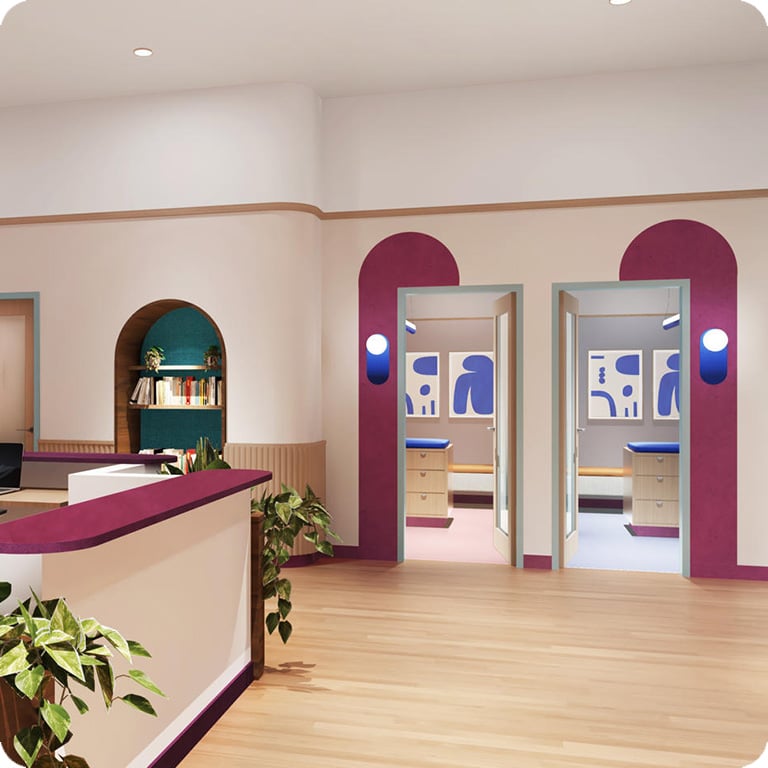
Zarminali clinic design offers aesthetic warmth and comfort without compromising safety and cleanliness. Each new location is designed around how humans — especially children — experience a space.
- Accents echo nature. Humans have an innate, often subconscious, need to connect with nature. You don’t have to know the term “biophilic design” to feel it. It’s the reason natural light matters. It’s why looking out a window helps you breathe a little easier. It’s why outdoor play is so important. Zarminali brings that instinct indoors.
- Materials are honest. You won’t find vinyl or polyester here. Looks like wood? It is. Specially treated wool and cotton fabrics feel soft and stand up to regular cleaning. Even clinical necessities like stainless steel fixtures are modified with matte finishes to reduce their cold, sterile feel. It’s still medical-grade without announcing itself as such.
- Tech enhances human touch, not replaces it. Zarminali clinics are deeply tech-enabled, but you won’t feel like you’ve walked into a sci-fi movie. Technology is used to smooth friction points, not to put screens between people. Coordination of care happens quietly in the background. Check-in happens before you arrive. Phones, paper charts, and payment stations are kept out of sight.
- Spaces are sensory-friendly. Invisible disabilities are designed for first — because when a space works for those who are most sensitive, it works better for everyone. Integrated sound systems dynamically reduce noise. Music and scent are approached cautiously, with careful consideration for allergies, sensitivities, and neurodivergent children.
- Curved lines replace sharp corners. Circular forms appear throughout the space. Circles are universally associated with peace, safety, and wholeness, and those associations operate quietly, beneath conscious thought.
- Interaction is encouraged. You can let your kid be a kid in our clinics. Nothing is too precious; everything is touchable and indestructible.
- Color is used with intention. Brand colors guide attention and create continuity across physical and digital experiences.
What You’ll Experience from the Moment You Arrive
Arrive with predictability, not pressure
As you walk into a Zarminali clinic, one of the first things you’ll notice is how intuitive the space feels.
The layout has symmetry. Design elements repeat. There are no unnecessary visual puzzles to solve. This isn’t accidental. Humans find comfort in order and predictability, especially when they’re already under stress — like having a sick little one.
That consistency extends across locations. Once you’ve been in one Zarminali clinic, you’re familiar with them all. Parents don’t have to relearn how to navigate the space. Kids don’t feel like they’re entering an unfamiliar world every time.
Waiting doesn’t feel like waiting
Waiting rooms are usually treated as a necessary inconvenience, the precursor to your “actual” care. But not at Zarminali.
Our waiting areas are intentionally generous and spacious. They’re designed for movement, play, and choice. Kids can explore and choose their favorite chair. Parents can settle in without feeling cramped. Some locations have separate areas for sick and healthy children.
When children can move and play, their bodies regulate more easily. This is especially helpful for children with sensory needs. Different children need different things. Some want stimulation. Others need quiet. By having the option to choose, they feel more in control, which is a powerful antidote to anxiety.
Behind the scenes, staff spaces receive the same level of care. Breakout rooms, collaboration areas, and quiet pods are built into the clinic — not because they’re “essential” in a traditional sense, but because clinician well-being matters. Reducing burnout supports better care for everyone.
Creating calm inside the exam room
Exam rooms are where anxiety often peaks — even with a caring and confident clinician. Zarminali exam rooms are designed to soothe anxiety and stress. It’s proven that a calmer child experiences less pain. A calmer parent can ask better questions. And a calmer clinician can provide better care.
The color palettes of exam rooms mimic the vibes of dawn and dusk. This isn’t for decoration, but to reflect research around how light at these times affects circadian rhythms and regulation. The result: A calmer, more cued-in exam with your pediatrician.
Experience our new clinics for yourself
Our clinic spaces are proof of what Zarminali believes: Families shouldn’t have to navigate alone, and technology should enhance (not replace) human care.
Our locations are expanding into new states and cities. Find the Zarminai Pediatrics clinic nearest to you.
You can read more about the design principles behind our clinics here.