




As a mom of a toddler and a new baby, I have been to a lot of well visits with the pediatrician over the past few years. At this point, I have the routine down: pack the diaper bag, bring a few distractions, and pull up the checklist of questions I always ask the pediatrician.
Trying to keep kids entertained in a waiting room can be chaotic, and it is surprisingly easy to forget the question you were sure you would remember. Having a go-to list on my phone helps me use our appointment time well and make sure I leave with the information I need.
Well visits are important to me because they give my child’s pediatrician a chance to check on growth and development, support their physical and emotional well-being, and offer preventive care and guidance. I also like that it gives me a space to bring up any concerns before they turn into bigger issues, and it helps me feel a little more informed about what might be typical right now and what could be coming next.
From one parent to another, below is my reusable list of questions to ask a pediatrician at a well visit. Every child and every appointment is different, so I also add questions that are specific to what each of my boys has going on at the time. Bookmark this page or copy the checklist into your phone before your child’s next appointment.
Questions to Ask a Pediatrician at Every Well Visit
-
Is my child’s growth tracking appropriately on their curve?
I always ask how my child’s weight and height or length compare with their previous measurements, rather than focusing only on a single percentile. For babies, I also ask about head circumference when it is measured. Children grow at different rates, and a pediatrician can explain whether the overall pattern looks steady or whether a change deserves a closer look.
This question can also open the door to discussing feeding, appetite, recent illness, activity level, or anything else that might affect growth. If the curve has shifted, I ask what the pediatrician thinks may be contributing, whether any follow-up is needed, and what changes, if any, they recommend at home.
-
How much should my child be sleeping at this age?
Sleep needs change quickly during infancy and childhood, so I also ask about the total amount of sleep my child should get in a 24-hour period, including nighttime sleep and naps. For a baby, I also ask how many naps are typical, whether frequent waking is expected, and whether our sleep setup still follows current safe-sleep guidance.
Sleep can affect mood, attention, learning, and behavior, but there is also a wide range of what is considered normal. I find that sharing my child’s actual sleep schedule helps the pediatrician give advice that fits our family. I also make sure to mention any sleep-related concerns I’ve noticed, such as snoring, pauses in breathing, very restless sleep, difficulty falling asleep, unusually early waking, or daytime exhaustion, rather than assuming it is just a phase.
- What should my child be eating, and how much should I offer?
Feeding recommendations shift with age, whether your baby is ready for solids, your toddler is suddenly selective, or your older child is going through a growth spurt. I ask which foods and textures to introduce, what portion sizes are realistic, and how many meals and snacks to offer.
This is also when I ask what to avoid, including choking hazards, guidance on allergen introduction, appropriate milk intake, iron-rich foods, and whether any vitamin supplements are needed. - Which developmental milestones should I look for now and before the next visit?
Instead of asking only whether my child is meeting developmental milestones right now, I ask what skills may emerge before the next appointment. That gives me a clearer idea of what to notice in the months ahead and how I can support development through everyday play, reading, conversation, and movement.
Development includes how children play, learn, communicate, behave, and move. A milestone checklist is useful, but it is not a pass-or-fail test. So I tell the pediatrician what I’m seeing at home, including any skills my child has lost or anything that feels different from their usual pattern. - Is my child’s behavior typical for their age?
Behavior can look very different from one stage to the next, and I’ve learned that what I worry about changes just as quickly as my child grows. With a baby, my concern might be intense fussiness or difficulty being soothed. With a toddler, it can be tantrums, biting, hitting, separation anxiety, or the ups and downs of toilet learning. As my child gets older, my questions will likely shift toward friendships, attention, school, mood, or anxiety.
When I bring up behavior at a well visit, it helps my pediatrician put what I’m seeing into developmental context and offer practical strategies I can actually use at home. I try to be specific about what is happening, how often it happens, how long it lasts, and whether it affects sleep, eating, learning, relationships, or daily routines. Sharing those details helps us figure out whether I’m seeing a common phase or something that might benefit from extra support or evaluation. - Which vaccines are currently recommended for my child?
Vaccine recommendations depend on a child’s age, previous doses, medical conditions, travel plans, and other individual factors. I ask which vaccines are recommended that day, what each one protects against, and whether my child is up to date or needs a catch-up plan.
I also ask about common after-effects, how to keep my child comfortable, and which symptoms should prompt a call to the office. Recommendations can be updated, which is one reason this is worth asking directly at every well visit instead of relying on an old schedule saved online. - What should I expect between now and the next well visit?
I end by asking, “Is there anything else I should be thinking about or watching for at this stage that we haven’t already covered?” Anticipatory guidance is one of the most useful parts of a well visit because it helps me prepare instead of searching for answers after a new phase has already begun.
Before leaving, I also confirm when the next wellness check should be scheduled and what signs or symptoms would warrant calling sooner—and add it to my calendar. That gives me a clearer plan for what to watch, what can wait, and where to turn if I am unsure.
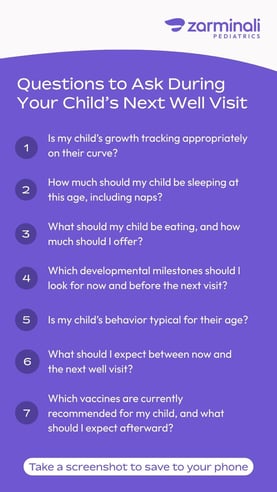
My Reusable Checklist of Questions to Ask a Pediatrician
Here is the shortened version I keep handy. I usually bring up my top concerns near the beginning of the appointment, so we do not run out of time:
- Is my child’s growth tracking appropriately on their curve?
-
How much should my child be sleeping at this age, including naps?
- What should my child be eating, and how much should I offer?
- Which developmental milestones should I look for now and before the next visit?
- Is my child’s behavior typical for their age?
- Which vaccines are currently recommended for my child, and what should I expect afterward?
- What should I expect between now and the next well visit?
Tracking Questions for Your Pediatrician Between Visits
To keep things simple and easy to access, I have a note on my phone for each of my boys. Whenever a question comes up, I add it to the list instead of trusting myself to remember it weeks later. I include the date, a short description, and, when helpful, a photo or note about how often something happens.
Before the appointment, I review the list and move the most important questions to the top. I keep the standard checklist above for every well visit, then add anything specific to that child, whether it is a new sleep pattern, a feeding concern, a behavior change, or a symptom I have been watching.
You do not need to arrive with a perfect, color-coded record. A basic running note is enough to make a busy visit feel more organized. More importantly, it helps ensure that the questions you meant to ask actually make it into the conversation.